 A1
Steam Locomotive Trust A1
Steam Locomotive Trust
The A1 Steam Locomotive Trust - a registered charity - has built a
completely new 'A1' to the original design and with the help of the latest
technology. Fitted with additional water capacity and the latest railway
safety electronics, Tornado is fully equipped for today’s main line
railway. |
 Abandoned Tube Abandoned Tube
The increased security levels in London mean that London Underground are
extremely unlikely to grant visits to their disused stations.
For those
who have wondered what those old stations look like, hopefully the
following photos will be of interest. |
 Abandoned-places.com Abandoned-places.com
Old buildings, abandoned hospitals, industrial palaces overgrown with
plants and trees, the remaining walls decorated with graffiti, smashed
windows, rain dripping through the roof... These places have become hard
to find, difficult (or illegal) to access, dangerous to explore ... great
to spend the day ! |
 ACORP.uk.com ACORP.uk.com
The Association of Community Rail Partnerships – ACoRP – is a federation
of over 50 community rail partnerships and rail promotion groups.
We are an organisation of ‘do-ers’, focused on practical initiatives which
add up to a better more sustainable local railway. Improved station
facilities, better train services and improved integration with other
forms of transport are central to the work of ACoRP and its members. |
 Bradford
Railway Circle.co.uk Bradford
Railway Circle.co.uk
We were founded in 1945 after a Bradford gentleman put an advert in the
Telegraph & Argus. We have about 100 members
and meet at 7.30pm on alternate Wednesdays, at Heaton Baptist Church, on
Leylands Lane in Heaton, Bradford.
Usually 30-or-so members are in attendance for each meeting, which may
comprise a slide or film show, quiz or discussion. |
 Britain
From Above Britain
From Above
Britain from Above presents the unique Aerofilms collection of aerial
photographs from 1919-1953.
We invite you to take part in helping us identify and provide information
about old aerial images of Britain. Simply register, search for images,
and contribute information. You can add to the factual summary, add
keywords, comments, photos and more. |
 Bronte-country.com Bronte-country.com
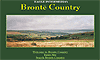
Welcome to Bronte Country, an area which straddles the West Yorkshire and
East Lancashire Pennines in the North of England. A windswept land of
heather and wild moors, it is hardly surprising that this region became
the inspiration for the classic works of the Bronte sisters, Charlotte,
Emily and Anne. |
 Bronte-country.com/great-northern-railway-trail. Bronte-country.com/great-northern-railway-trail.
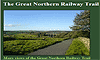
The Great Northern Railway Trail is a recently developed cycle path and
public bridleway which follows a section of the route of the (now disused)
railway line which used to run from Queensbury through the villages of
Clayton, Thornton, Denholme, and Cullingworth en route to the Worth Valley
and meeting the main line near Keighley. |
 Christian
Wolmar Christian
Wolmar
Christian Wolmar is a writer and broadcaster specialising in transport. He
has spent nearly all of his working life as a journalist, and was at The Independent from 1989 to 1997, mostly as transport correspondent. Although
he mainly concentrates on transport matters, he covers other social policy
issues and has written on a wide range of subjects. |
 Cumbria Railways
.co.uk Cumbria Railways
.co.uk
The Cumbria Railways website by Peter Burgess is dedicated to the lost
railways of Northern Cumbria which have all closed during the last
century. Many of the Cumbria Railways lines closed due to the decline in
the industries that they serviced so well during their heyday such as Coal
Mining, Iron Ore Mining and Steelmaking along with the Beeching closures
of the early 1960s. |
 Darkplaces.co.uk Darkplaces.co.uk
UK Underworld - You die... We split your kit! Never underestimate the
power of stupid people in large groups.
Darkplaces is an independent meeting point for all underground related
explorers to chat, meet, share information, show off pictures and videos
about exploring underground places of Interest. |
 Davidheyscollection.com Davidheyscollection.com
This website is intended to be a good-humoured look at contemporary
attitudes and lifestyles; a personal observation of a gentler, more
innocent age. The pages cover the period from the post-war Fifties to the
vibrant 'Swinging Sixties' - which, for my generation, brought up on a
diet of jam butties and roly-poly pudding, was something of a 'Boy’s Own'
adventure, if you like. |
 Deltic Preservation Society Deltic Preservation Society
The Deltic Preservation Society Ltd is the largest diesel locomotive
preservation society in the United Kingdom, and owns three of the six
surviving Deltics. A total of 22 Deltics were built for British Rail in
1961/62, for use on the East Coast Main Line out of Kings Cross. By the
late 1970s, they were being replaced by new Inter-City 125 trains, and
were gradually phased out. |
 Disused Stations Disused Stations
People have always had a fascination with disused railway lines and
stations. Following the opening of the first railway lines in the 1820’s,
stations have been closing; many in the last century because they were
resited to a more suitable location. This is particularly true in London
where many of the London termini were originally built some distance short
of their present site. |
 Durham
Mining Museum Durham
Mining Museum
This site covers mining in the Northern part of England i.e. County Durham
(DUR), Northumberland (NBL), Cumberland (CUL), Westmorland (WES) and the
Ironstone mines of North Yorkshire (NRY). |
 Eagle.co.uk/steam Eagle.co.uk/steam
Links to (mainly UK) based steam resources: |
 Embsay
and Bolton Abbey Steam Railway Embsay
and Bolton Abbey Steam Railway
Travel between Embsay station, built in 1888, and the new award-winning
station at Bolton Abbey. Your journey takes you through picturesque
Yorkshire Dales scenery. Bolton Abbey station is the ideal stopping off
point for a pleasant one and a half mile walk to the ruins of the 12th
Century priory. |
 End
of the Line End
of the Line
Over the years there have always been a number of
locomotives in storage at various locations around the country but
following the privatisation of the British Railway’s network, from the mid
1990s onwards, the number of locomotives in storage has increased
dramatically. |
 Flickr.com/groups/leedsrailways Flickr.com/groups/leedsrailways
Flickr.com/photos/rikj
Flickr.com/photos/phill_dvsn/collections/72157600204027395
Flickr.com/photos/phill_dvsn/sets/72157594397421428 |
 Forgottenrelics.co.uk Forgottenrelics.co.uk
It's easy to take for granted the awesome endeavours of 19th Century
railway pioneers. It was an age of speculative adventure, built on
innovation, will power and elbow grease. But many magnificent creations
were abandoned during the industrial vandalism of the fifties and sixties.
Forgotten Relics of an Enterprising Age celebrates some of them. |
 Friends
Of Hebden Bridge Station Friends
Of Hebden Bridge Station
The "Friends of Hebden Bridge Station" was formed in September 2007 to
help keep the station environs tidy, maintain the gardens to the station
entrance and approach, and provide a library in one waiting room for rail
users. |
 Friendsofoakwellhall.org.uk Friendsofoakwellhall.org.uk
Founded in 1988, the Friends of Oakwell Hall and Country Park are a
voluntary support group for this wonderfully authentic 16th Century Manor
House in Yorkshire - and for its surrounding 110 acres of country park. |
 Historic
England Historic
England
Search an online map of aerial photographs from the last
100 years. |
 Interreg
Ivc Interreg
Ivc
INTERREG IVC provides funding for interregional cooperation across Europe.
It is implemented under the European Community’s territorial co-operation
objective and financed through the European Regional Development Fund (ERDF).
The overall objective of the INTERREG IVC Programme is to improve the
effectiveness of regional policies and instruments. |
 irail.co.uk irail.co.uk
Index of all railway and model railway related websites in the UK and
Ireland |
 Keighley and Worth
Valley Railway Keighley and Worth
Valley Railway
When British Railways closed the line in 1962, local people and railway
enthusiasts joined forces to try and save it.
A Preservation Society was formed and after many years of volunteer
struggle the line re-opened to passenger traffic on 29th June 1968. |
 Kirklees
Light Railway Kirklees
Light Railway
Coal traffic ceased completely in 1979 on the Clayton West branch and with
dwindling passenger numbers the railway was finally closed in 1983. Around
this time Brian & Doreen Taylor had established a miniature railway at
Shibden Park in Halifax. Brian however wanted to get his teeth into
something bigger and began a search for somewhere to build a 15 inch gauge
railway. |
 London
underground-history.co.uk London
underground-history.co.uk
One of the things I find most interesting is the changing history of the
railway, of which there is still much hidden evidence. For example, look
through the window as you travel between Tottenham Court Road and Holborn
on the Central Line and you'll see a station - where no passengers have
alighted since 1932. These stations are often referred to as ghost
stations. |
 Maggieblanck.com/Land/PhotosBatley
See also
Maggieblanck.com/Land/PhotosBirstall Maggieblanck.com/Land/PhotosBatley
See also
Maggieblanck.com/Land/PhotosBirstall
Batley is a very old town in the West Riding of Yorkshire. It was
mentioned in the Doomsday Book in 1086 and was listed in the 1379 Poll
Tax. The parish church, All Saints, dates in part, to the 15th century.
Today, other than the parish church, little remains of very old Batley.
There are still some vacant mills from the early 1800s and some Victoria
buildings. |
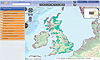 Magic.gov.uk Magic.gov.uk
The MAGIC website provides authoritative geographic information about the
natural environment from across government. The information covers rural,
urban, coastal and marine environments across Great Britain. It is
presented in an interactive map which can be explored using various
mapping tools that are included. Natural England manages the service under
the direction of a Steering Group who represent the MAGIC partnership
organisations. |
 Middleton
Railway Middleton
Railway
The railway made preservation history by becoming the
first standard gauge line to be run by volunteers. In late 1959 Leeds
University Union Railway Society were looking for somewhere to build and
run a small railway. Several options were discussed until eventually the
Middleton Railway was decided upon. The society moved into Claytons Yard. |
 Mirfield memories
/ Railways Mirfield memories
/ Railways
The "death sentence" has been issued to two of Mirfield's three railway
stations; but local people are seeking a reprieve.
Notices, stating that all new line stations are to be closed, have been
circulated by the railway executive, which means that the two local
stations, Northorpe (higher) and Battyeford, will cease to operate a
public service. |
 National
Coal Mining Museum National
Coal Mining Museum
The National Coal Mining Museum for England is located at Caphouse
Colliery, on the western edge of the Yorkshire coalfield, where mining has
been carried out for centuries. A plan dated 1791 showing workings from
1789 to 1795, includes a shaft on the Caphouse site. It is probably the
oldest coal-mine shaft still in everyday use in Britain today. |
 National
Railway Museum National
Railway Museum
Welcome to the National Railway Museum – the largest railway museum in the
world, attracting almost 1 million visitors per year to our sites at York
and Shildon. Discover over 300 years of history and over a million
wonderful objects.
Marvel at iconic locomotives, watch engineering work in progress in the
Workshop, browse our object-filled Warehouse. |
 North
Yorkshire Moors Railway North
Yorkshire Moors Railway
The North Yorkshire Moors Railway operates steam trains along an 18 mile
line between the market town of Pickering and the village of Grosmont,
through the heart of the North York Moors National Park. We are also
operating trains to Whitby on certain days of the year. The railway passes
through a variety of scenery, from wooded valley to heather clad moorland. |
 Office
Of Rail Regulation Office
Of Rail Regulation
The Office of Rail Regulation is the independent safety and economic
regulator for Britain's railways.
The ORR is led by a Board appointed by the Secretary of State for
Transport.
|
 Old
Maps.co.uk Old
Maps.co.uk
Old-Maps is the UK's most comprehensive historical map
archive comprising site centred historical maps covering England, Wales
and Scotland.
We provide a complete step by step picture of land use
changes that have taken place from the mid-19th Century onwards. |
 Penistone
Line Partnership Penistone
Line Partnership
The Penistone Line Partnership is a voluntary organisation which supports
and promotes community involvement along the Huddersfield to Sheffield
railway line. Many events are run during the year including music trains
and guided walks from Penistone Line Stations. |
 Pennine Waterways Pennine Waterways
This website is dedicated to the canals of the south Pennines, UK,
Including photographic virtual cruses along these canals.
The site also features extensive photo reports on the completed
restoration work on the Huddersfield & Rochdale canals |
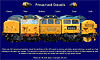 Preserved-diesels.co.uk Preserved-diesels.co.uk
There are 367 preserved mainline diesel locomotives in the UK based on
various privately owned railways, as well as a few running on the main
rail system. This website is intended to provide a photographic record of
each of these engines as well as details of the lines on which they are
based and details of any diesel events. |
 Procast.co.uk Procast.co.uk
Established for over 20 years, Procast has gained an enviable reputation
for the specialist production of high quality ferrous and non-ferrous
nameplates, signs, engineering components and decorative castings. |
 Queensburyvillage.co.uk Queensburyvillage.co.uk
How did Queensbury get it's name? Why was a blunderbuss fired in
Queensbury every night? Why does Ambler Thorn have a Cape of Good Hope?
Read our things you (probably) did not know about Queensbury... |
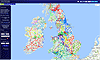 Railmap
On Line Railmap
On Line
Historic railways, railroads and tramways.
RailMapOnline.com provides interactive maps of past & present railways. |
 Railway Ramblers Railway Ramblers
As you may gather from the title, we are a club that likes to explore
disused railway lines. We organise walks throughout the country, for
people of varying ages and abilities, usually on disused railways,
although sometimes we explore old canals and, occasionally, even Roman
roads. We are not a high-powered hiking club concerned mainly with
clocking up the miles. |
 Red
House Red
House
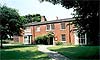
Red House in Gomersal, a village south of Bradford was once the home to
Charlotte Bronte's close friend Mary Taylor, and is beautifully furnished
as a family home of the 1830s. Charlotte visited there often in the 1830s
and the Taylors appear as the "Yorkes" and the house as "Briarmains" in
her novel Shirley. |
 Royal
Scots Grey Royal
Scots Grey
Our Mission is to ensure that 55022 is preserved in running order with
mainline certification. This site is dedicated to the promotion of that
mission and to help to raise funds to protect this important piece of
British railway heritage. |
 Signalling
Record Society Signalling
Record Society
The Society maintains and shares knowledge of Railway Signalling and
Operation in the British Isles and Overseas.
Everything from the present day signalling to the earliest times. |
 Skipton
East Lancs Railway Action Partnership Skipton
East Lancs Railway Action Partnership
We are a volunteer campaign group whose aim is to campaign for the
re-instatement of the Colne-Skipton line as a trans-pennine route, a part
of the national network, linking the Aire Valley and Yorkshire to East
Lancashire, Manchester, Preston and beyond. |
 Subterranea
Britannica Subterranea
Britannica
Formed in 1974, Subterranea Britannica is a society devoted the the study
and investigation of man-made and man-used underground places. Subterranea
Britannica brings together people with an interest in all types of
underground space - from deneholes to dug-outs and from souterrains to
subways. |
 Sustrans.org.uk Sustrans.org.uk
Sustrans is the UK's leading sustainable transport charity. Our vision is
a world in which people can choose to travel in ways that benefit their
health and the environment. Every day we are working on practical,
innovative ways of dealing with the transport challenges that affect us
all. |
 Tunnels
uk.com Tunnels
uk.com
This site was going to be dedicated to the cataloguing, discussion and
exploration of rail tunnels in the UK - but now I don't know if I have the
time!! I may just use it to record my site visits as well as including the
database - we'll see how it goes. |
 Trainline Trainline
We are Europe’s leading train and coach app. To put it simply, we are a
one-stop-shop for train and coach travel.
Every day, we gather routes,
prices, and travel times from over 270 rail and coach operators in 45
countries,
so that everyone can buy tickets quickly and save time,
effort, and money. |
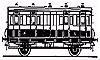 Vintage Carriages Trust Vintage Carriages Trust
The Vintage Carriages Trust is a volunteer body, based on the Keighley &
Worth Valley Railway. It was formed in the late 1960s by a group of
volunteers whose interest was in wooden bodied carriages. They could see
that there was a need to concentrate on the preservation of these historic
items which were in grave danger of disappearing due to the weather and
vandalism. |
